shall we?
shitsrael is illegally blocking the Global Sumud Flotilla and arresting the activists as I write.
the time is now
in Italy we’re already blocking roads and major stations
let’s use our white privilege to end a genocide
shall we?
shall we?
shitsrael is illegally blocking the Global Sumud Flotilla and arresting the activists as I write.
the time is now
in Italy we’re already blocking roads and major stations
let’s use our white privilege to end a genocide
shall we?
I think in general you’ll find agreement here, but please keep discussion relevant and our code of conduct in mind:
Stu yells this or something quite similar somewhere in 10/31/22. I think Gaia maybe?
I wish we would get down with the general strike concept here. I fear we’re past the point where it would be effective though. Wouldn’t be at all surprised if it was declared an act of terrorism and the army was called in…
I’m both an anarchist and accustomed to white-European level free speech, but I’d never – and I won’t – forget the code.
Seriously, I started the thread because I want to discuss the topic and get some u.s.’ perspective. I will speak my mind – in a language that I started studying at 10, mind you.
That is, before assuming I’m saying something really horrible, maybe ask.
Also, please understand that all this decolonisation stuff is personal to me.
– — –
Sooooo
With all this out of the way, can we all agree that we (the weirdo swarm) all benefit from white privilege?
That the acknowledgement of such privilege is the first step, but it’s nowhere near moral enough? That action is?
p.s. I’m slowly putting together an answer to Listening_wind.
All good, I know you’re a valuable contributor here. For a topic like this I just wanted to generally make sure it’s known, mostly to stop anything devolving before it starts.
Yes I can agree. I look like the members of King Gizzard and I come from more or less the same cultural and economic context. They make their views clear and at this point most people wouldn’t be here if they didn’t agree or weren’t able to tolerate that.
Sorry for taking so long. As you know, things kept happening – things relevant to the the topic and also to me personally, both as a (minor) activist and privately.
One of such things looks to me a good way to start this attempt to put down in words what I’m trying to say.
You probably know about the thick black line that spans a century of Italian history and which ties the original fascist movement to our present government.
I think you’re all familiar with the current Presidente del Consiglio dei Ministri, giorgia meloni, the first woman in that position; you’ve recently seen her wagging her tail at the table where the orange baby, always squealing, sat.
Less known champions of our particular incarnation of this neofascist surge include:
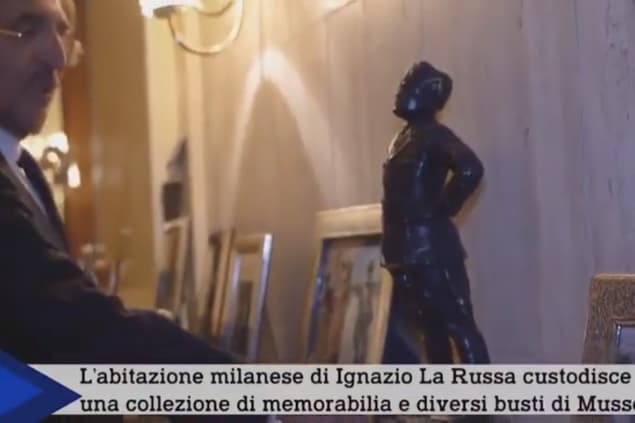
ignazio la russa, Presidente del Senato – the second highest office in Italy after the Presidente della Repubblica – who proudly shows to the cameras his bust of mussolini
and maurizio gasparri, senatore della Repubblica. If you suffer from low self-esteem, just look up the cv and the deeds of this nonentity.
The latter is the author of bill ddl1627, being currently discussed, in which:
. antisemitism and antizionism are conflated, as per ihra’s indications - therefore prohibiting the expression of negative opinions on the shitsraeli government;
. lifelong education courses are estabilished for basically all categories of public workers, among which teachers, police and judges, in which such conflation is presented as true and urgent;
. similar education courses are estabilished for school pupils of all age.
Yes, you’ve read it correctly: a fascist in a government of fascists has just farted a bill in which, under the guise of fighting the hatred against jews, free speech against the government of the zionist occupation entity is prohibited.
So, what happens if a teacher answers to a question by one of his students, for instance “why are they still bombing Gaza after the truce?”, with the truth? They risk up to nine years in jail.
What if a colleague of the teacher knows about the fact but omits to report it to the police? That’s six years.
You can go and check for yourself: https://www.senato.it/service/PDF/PDFServer/BGT/01473422.pdf
It’s in italian, but having been written by gasparri, it’s both short and simple.
Now, freedom in teaching is mandated by the Costituzione della Repubblica Italiana. How did we get to outspoken fascists trying to democratically rule about what a teacher can and can’t say?
The point I’d like to make is that we’ve been there since forever: I don’t live in a democracy - and neither do you, by the way.
Unless, that is, democracy is reduced to “where elections are held and you can vote for more than one party” - two, in your case (I mean, who the **ck is Jill Stein, right? Can you seriously vote for her, right?)
If such a description of democracy is good for you, then yes: I live in a democracy, you live in a democracy, and citizens in the West Bank live in an apartheid ethnostate, but still in a democracy (the only one in West Asia, no less!)
But while we all know the etymology of the word - government by the people - the long and fertile philosophical debate around the concept is generally unknown to the general public. The complexity of such matter is beyond the scope of this already too long text, but if you’re curious, a good starting point could be the concept of parrhesia.
There is a quote I find particularly poignant: democracy is the place where no piece of knowledge is lost. (I’m quoting by heart and have not been able to go back to the author, I’m afraid).
How does this sound?
Let’s hear Chomsky:
«The smart way to keep people passive and obedient is to strictly limit the spectrum of acceptable opinion, but allow very lively debate within that spectrum – even encourage the more critical and dissident views. That gives people the sense that there’s free thinking going on, while all the time the presuppositions of the system are being reinforced by the limits put on the range of the debate».
[here: Selections, by Noam Chomsky (Excerpted from The Common Good)]
Starting to sound familiar?
He’s even clearer in this 1986 interview:
Interviewer: «C.P. Otero […] has written […]: “The totalitarian system of thought control is far less effective than the democratic one, since the official doctrine parroted by the intellectuals at the service of the state is readily identifiable as pure propaganda, and this helps free the mind.” In contrast, he writes, “the democratic system seeks to determine and limit the entire spectrum of thought by leaving the fundamental assumptions unexpressed. They are presupposed but not asserted”.»
NC: «That’s quite accurate. […] Take, say, a country which is at the opposite end of the spectrum from us domestically, the Soviet Union. […] In a country like that, where there’s a kind of Ministry of Truth, propaganda is very easily identifiable. Everybody knows what it is, and you can choose to repeat it if you like, but basically it’s not really trying to control your thought very much; it’s giving you the party line. It’s saying, “Here’s the official doctrine; as long as you don’t disobey you won’t get in trouble. What you think is not of great importance to anyone. If you get out of line we’ll do something to you because we have force.”
Democratic societies can’t really work like that, because the state can’t control behavior by force. It can to some extent, but it’s much more limited in its capacity to control by force. Therefore, it has to control what you think. And again, democratic theorists have understood this for 50 or 60 years and have been very articulate about it. If the voice of the people is heard, you’d better control what that voice says, meaning you have to control what they think. The method Otero mentions there is one of the major methods. One of the ways you control what people think is by creating the illusion that there’s a debate going on, but making sure that that debate stays within very narrow margins. Namely, you have to make sure that both sides in the debate accept certain assumptions, and those assumptions turn out to be the propaganda system. As long as everyone accepts the propaganda system, then you can have a debate».
[here: Selections, by Noam Chomsky (Excerpted from Chronicles of Dissent)]
Now, being familiar with things like Euclid’s Elements and the 21 centuries spanning subsequent attempts to prove the 5th postulate it spawned, and having a general grasp of how the brain works (I’m thinking Kahneman’s fast and slow systems), these quotes by Chomsky are as clear as they can be, to me.
I’d like to offer you this perspective: everything follows previous things, and we can go back as much as we want, until we meet axioms. Those are assumptions, unproven and needed to ignite the theory. Either we’re familiar with them, or they act upon us unnoticed, as phantoms - and if it reminds you of a certain “spectre haunting Europe”, yeah, that’s an analogy that came to my mind as well.
Have you ever played “what are my assumptions?” Works equally well both as a dinner talking point and as a solitary mind game.
At this point, one may have started to ask themselves why.
If you agree we’re in a capitalistic society, then you may acknowledge that the expression “follow the money” is a solid piece of advice, when looking for reasonable explanations.
For instance, if you still haven’t, you should read the UN report
From economy of occupation to economy of genocide
Report of the Special Rapporteur on the situation of human rights in
the Palestinian territories occupied since 1967, Francesca Albanese
https://docs.un.org/en/A/HRC/59/23
and familiarise yourself with the sanctions imposed upon her by the US. (The problem is that they can’t get to her via the usual means, because she works pro bono).
You see, you have the right to free speech - as long as you’re not dumb enough to actually try it.
Would you say that these words of mine amount to an accurate portrayal of western societies, or have I been somewhat unfair?
Is capitalism amendable, or do you think - like I do - it urgently needs to be dismantled?
Ok, I’ll stop here. I have 15 more lines of just keywords or key-concepts, each one eager to be made into an endless doggerel, just to make sure nobody even dreams about reading this stuff.
But although I tend to lean on the didascalic side - I know and I’m sorry, but there’s a couple of good reasons for that - I am sincerely interested in your perspective.
So, what do you make of it?
(i have so much to say)
That bit by Chomsky on limiting the range of debate but encouraging dissent within the acceptable range is especially fascinating.
Got any weed you can share with me?
thank you for getting through that 
Heartwarming anecdote. There’s been a moment in our life when my sister and I were both studying Chomsky. She was graduating in modern literature, I was graduating in maths. She was specialising in linguistics, I had chosen logic.
I got to know the man coming from logic, and I remained totally ignorant about his political thought until very recently: I was reading a long form
it was suggested by someone on this forum, though I couldn’t get back and pin down whom
In the part I haven’t written I was going to talk about Mark Fisher’s Capitalist Realism. If you’re not already familiar with his work, may I suggest you read It’s easier to imagine the end of the world than the end of capitalism, the first chapter from the book I mentioned.
What I was going to say is that Fisher largely takes Chomsky’s point you were quoting and move it towards those axioms I was referring to in the long post. Hopefully written in a slightly better form – I trust in the reader to understand what I just wrote.
I’ll close with this guy I follow on ig https://www.instagram.com/reel/DRATetSiH0l/